
Prudence Mary Hemming, Writers SA
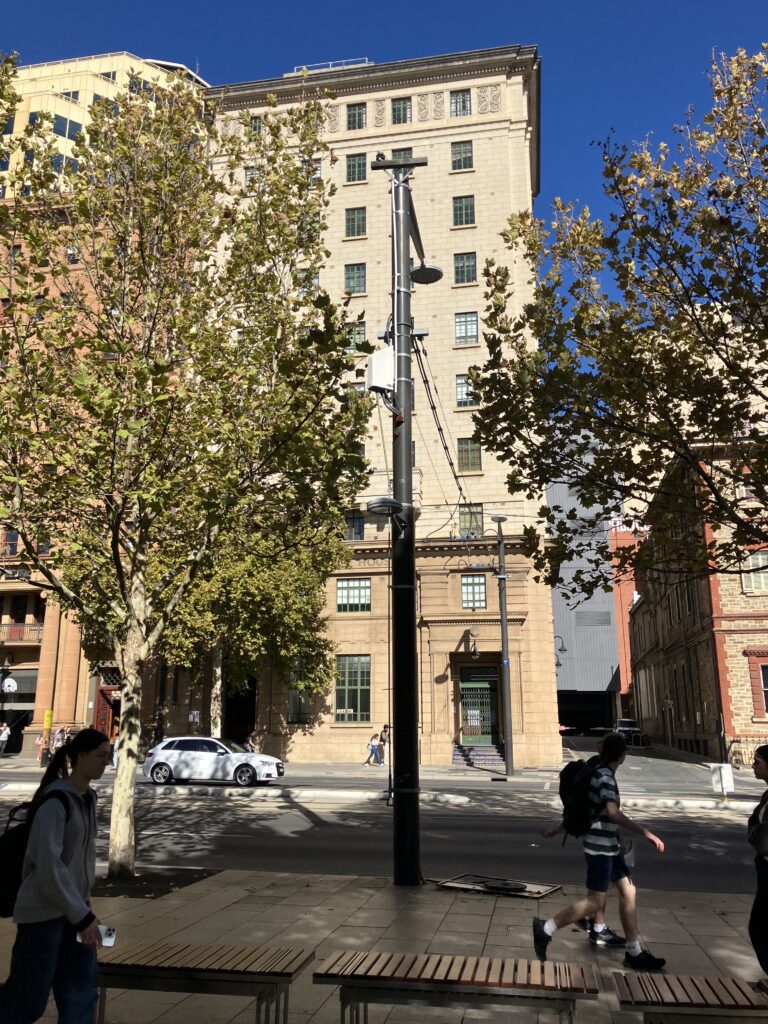
Walking views # 1
- In cases where young girls and women survive sexual violence, they may spend the rest of their lives living outside their bodies, unable to find ease and safety in places where violence goes unnoticed. A young girl never transitions into a young woman who matures into middle age; she may only revisit the city of her youth in her later years before reaching her final resting place.
- 1972 aged seventeen, along with many young girls in Adelaide, she is sexually assaulted—crossing the street, she starts walking on air.
- When the perpetrator died, it was shocking to realise the depth of silence that had concealed his crimes and kept them hidden; at last, I was free to walk the streets. Here, I discovered the perpetrator’s remains. He was buried with full honours, protected by the wealth and privilege of Adelaide’s elite.
- Disembarking from the bus at the War Memorial on the corner of Kintore Avenue and North Terrace, I walk no more than 200 steps, passing the white marble statue of Venus1 and the life-size bronze of Dame Roma Mitchell.2 From her seat under the elm trees, Dame Roma observes the comings and goings she failed to notice during her lifetime. I cross the tram tracks on North Terrace and, pushing against the double oak doors, step into the giant clamshell on the green floor. The lift takes me to the floor where my name is written on the door. I don’t know how long I’ve been here.
Stop motion walking views # 2
- After the assault, I lived with recurring flashbacks that erupted without warning. Each time, an explosion within me would turn my vision to stone. Later, I would return, startled to find I was in the same body. Following these episodes, I kept a watchful eye on the landscape, remaining on high alert.
- —walking along Gawler Place, she collapses.
- 1968—In the city of Adelaide, with coordinates 34.92547 degrees S 138.60063 degrees E, a well-to-do stockbroker is seen slowly moving across the street, leaving his four-floor office on the corner of King William and Grenfell Streets just before lunchtime. He turns left into Exchange Lane, walking no more than 148 steps before stopping at the stock exchange building,3 notable for its distinctive red stucco tower. Later in the afternoon, the same man continues along Gawler Place, turning left into North Terrace, then left again into Club Lane. He enters the exclusive men’s club4 through the side entrance, where he meets friends for dinner.
- From my west-facing window on the upper floor, I have a bird’s-eye view of the buildings at the corner of King William Street and North Terrace. One day, I saw a young woman lying face down on the footpath.
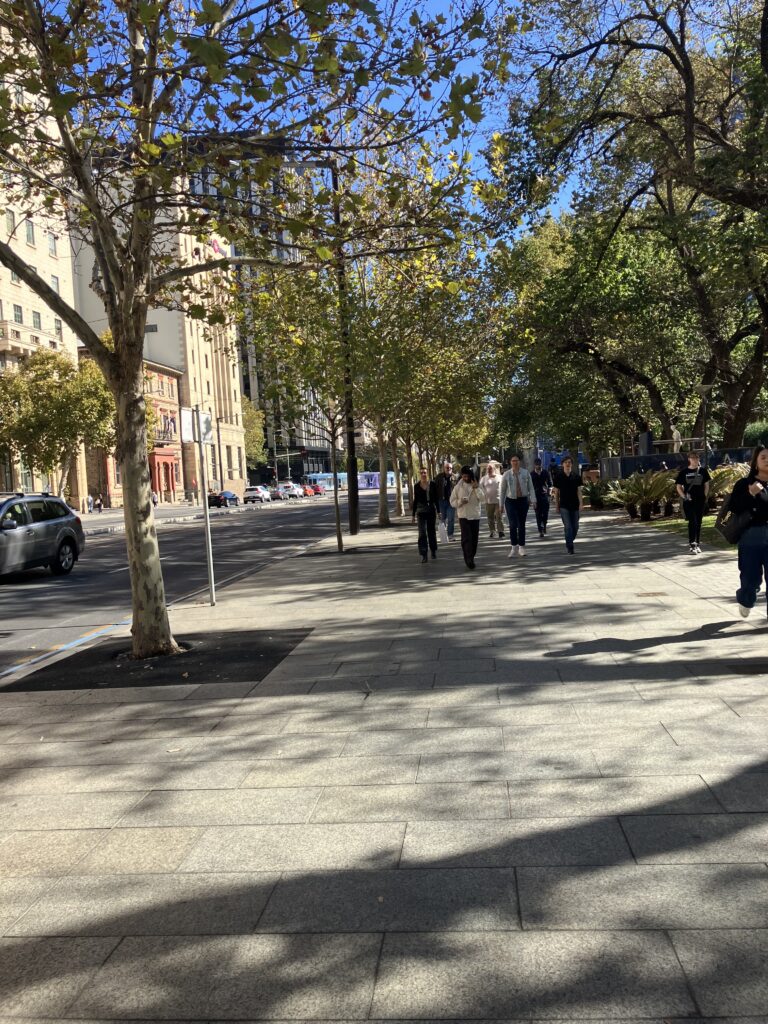
Image: ‘Footpath west along North Terrace, Adelaide, past the statue of Venus,heading towards the Dame Roma Mitchell Statue’, 2025, photograph. Source: Prudence Hemming.
Bird’s eye walking views # 3
- Over time, I developed the ability to see my surroundings as a form of remote viewing. Looking down on the grid-like map of the city, the details of movement on the ground become less distinct. As I ascend higher into the sky, people first appear as objects in the landscape, then as light smudges, before vanishing altogether.
- —her feet leave the ground—from this distance, her body appears lifeless.
- Not only in dreams, but also while I’m awake, my brain is working overtime to stay alive. I often drive around late at night when I can’t sleep. I’ve been told this is what barn owls do: fly at night. Recently, while I was checking Google Maps on my iPhone, my mother, brother, and father crossed over from my iPhone into Google Maps, rising in unison from their funeral home viewings across the greater Adelaide area. The only missing body from this gallery of levitating ghosts was the perpetrator who lies in state.
- The mid-century furniture in my room comes from the era when my life came to a standstill. I like the green carpet adorned with pink and black dots. In the afternoon, the north-facing window casts shadows across the eastern wall. No one sees me here.
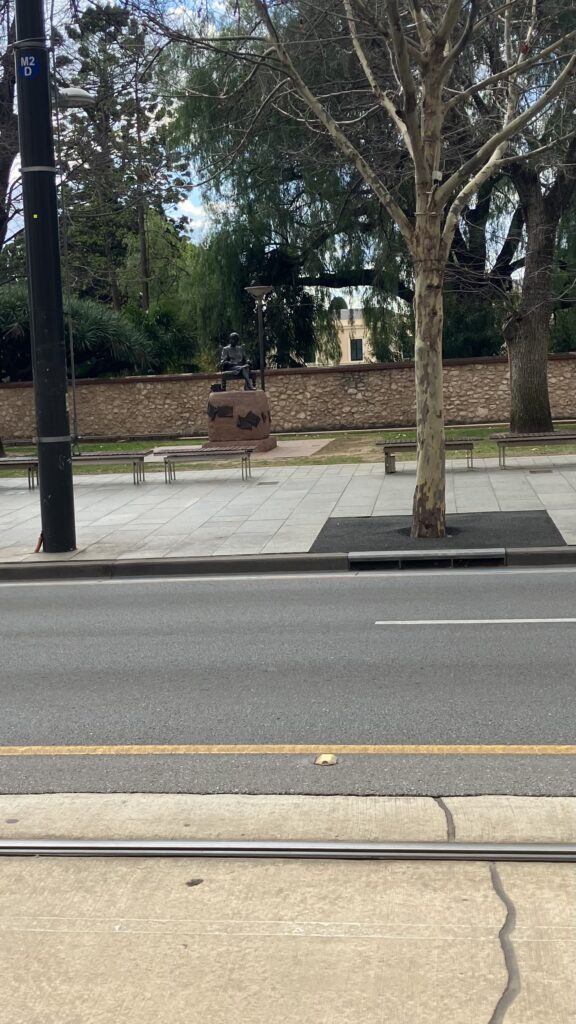
Ground level walking views # 4
- The thought of wandering through the city sends shivers down my spine. Anyone who knows the perpetrators’ daily walking routes would be afraid to cross their paths. You begin wearing dark glasses to catch glimpses of the city’s lovely streets, but this doesn’t stop car and smoke smells from invading your nostrils. When these tastes and smells sync with the surrounding landscape, a survivor makes contact with reality.
- —continuing along North Terrace—ambulance sirens— traffic stops —keep walking.
- For most of my life, I have been compelled to run from danger. However, this time, following the news of the perpetrator’s death, instead of fleeing, I leased an upper-floor room facing Government House and next to the Adelaide Club. From this vantage point, looking north across the plains and west to the sea, my writing began.
- In the room. Handwritten words lie scattered across the floor; stacks of paper with no page numbers; everything is out of order. Looking out the window, a bank of cloud hovers above the horizon; young women, their feet leaving the street below, appear in the sky, a flock of them —walking — soon it rains.
Ms Prudence Mary Hemming
pruehemming@adam.com.au
Acknowledgements: Adelaide CBD street names: King William Street, Pirie Street, Exchange Place, Gawler Place, North Terrace.
About the Author: Prudence Hemming is a creative writer living in Adelaide, South Australia. With a background in the performing arts, she has also written scripts for radio broadcasts and theatre. She has received Literary Fellowships from the Literature Board of the Australia Council and is currently working on a series of interweaving novellas. This submission is drawn from her current research and writing.
Notes:
- The Venus white marble replica statue of Venere di Canova (Canova’s Venus), unveiled in September 1892 and relocated to its present site on North Terrace west of Kintore Avenue in 1960. https://sahistoryhub.history.sa.gov.au/things/venere-di-canova/ ↩︎
- Life-size bronze sitting statue of Dame Roma Mitchell (1913-2000) sculpted by Janette Moore, unveiled in 1999.
Front inscription on the pedestal reads:
The Honourable Dame Roma Mitchell
Governor of South Australia 1991 – 1996
Chancellor of the University of Adelaide 1983 – 1990
Judge of the Supreme Court of South Australia 1965 – 1983 ↩︎ - The Stock Exchange, 53-57 Exchange Place, west of Gawler Place, built in 1901. See History Trust of South Australia, ‘The Stock Exchange’.
https://www.experienceadelaide.com.au/heritage-places/riaus-former-adelaide-stock-exchange-53-57-exchange-place-adelaide ↩︎ - The Adelaide Club, 165 North Terrace, Adelaide, founded in 1863 and built in 1864 as an exclusive gentlemen’s club:
https://sahistoryhub.history.sa.gov.au/organisations/the-adelaide-club/ ↩︎