
Kendrea Rhodes, Flinders University
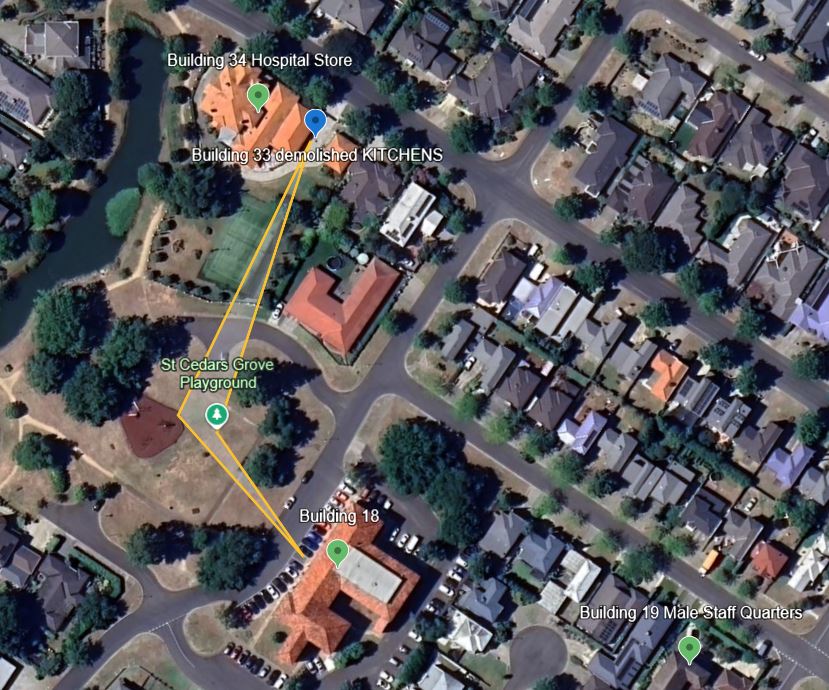
I am not walking, I am flying. Sucked face-first through charged beams of blue light, curled fingers grasping me by the eyeballs, cradling my white, sighted privilege in a zone sieved of moisture, of sustenance. Zooming headlong, feet flapping behind me in the winds of my mind, I race into the familiar embrace of an overlarge, ultramarine sphere splashed with fluffs of white and floating scabby skins—olive, jade, khaki, green. This earthy representation feels very real, clearly relying on my protective affinity. Australia must be on the other side (did I erase my origins with VPN … Back, does it work?). I turn and spin, anxious dry eyes cannot focus. Closer, closer. I had typed in Central Park Lake Gardens Victoria, hoping to see remnants of the old Ballarat Asylum, hoping to trace a path between the few remaining institutional buildings that escaped demolition in the 90s. Seeking just a trace of myself, of my great-grandfather, of Wadawurrung First Nations peoples upon this inspirited earth. Peace finally arrives as I slow my attention, focus my eyes, and settle upon a fired-clay tiled roof; one roof in an army of dark grey rooves, organised in rows, spaced out by design, divided by charcoal-blue bitumen roadways. Toy cars. Green shrubby splotches. Severe orderliness. Logical. Would artificial intelligence create it this way? I need to get to the road, to walk around, to control my own direction and speed. My flight along the data stream was unexpected, it was more than momentarily marvellous, it was briefly corporeal. I land and look for arrows that will give me control and manoeuvrability, hang on, am I confused with some other software? Double click to zoom in, click drag to move around, add a place mark (37°32’41″S 143°49’04″E), elation; target acquired. Now, disembark and free-walk the site … how to find old buildings that only exist on old maps after suburban repurposing?
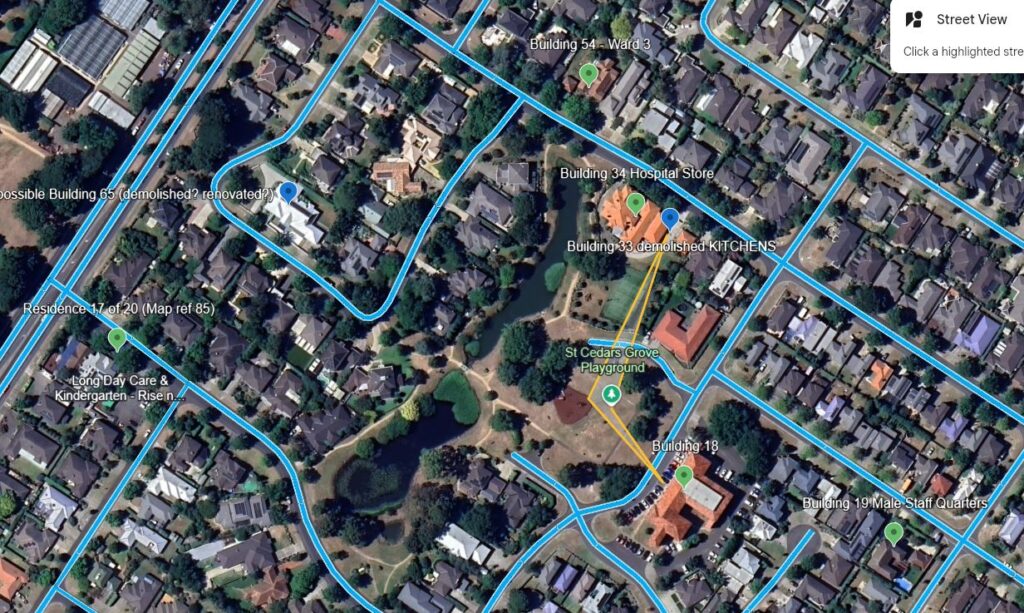
Archaeologists and historians do this … should have watched more Time Team. And yes, I am confused. Switching to Maps now … two tabs open, one walking, one flying. This is free fun. There’s a whiff of contemporaneity coming from the satellite image. I feel the message of familiarity it sends, matching my need for nowness. I walk in real time as my dexterous fingers tap the arrow keys in tempo with the mind-software network: up, down, back, forward, left, right, down, down, back, back, right, left, forward. I actually might find the old buildings at this rate, and I might be able to walk my great-grandfather’s oft trodden path between his ward and his work at the Ballarat Asylum. Switching to Earth now: Historical Imagery … Timelapse … time lapses … blurred 1985 (that’s how I remember it … is the software adapting to my current memory status?), 2004 same place, different skin … flight animation … speed … no one walks anymore. Physically puffed from adrenalin surges, my body reaches for the place. I am here but missing the foot-slapping earthen exchange. The mowed lawn smell. The sweet magpie song, overhead cawing crows, the charcoal and smoke on the wind, the wind. Leaves blowing in little autumn whirlpools. Signs of Wadawurrung Country. The ground is wrong. Wrong-ground. Wronged ground. My absent-presence—clever brain, blocked out the nothingness with a whole heap of pretend somethings, and I am playing. I thought Google might have secrets, like an archive. Reading with and against the grain. But I also need context, and I wonder if this is deliberate, to get my brain to do half the work? Did I just volunteer my imagination to the spongey corporate conglomeration? So, I resign. I will not see Wadawurrung Indigeneity, Mad histories, or my great-grandfather’s footsteps. Google is homogenous, vanilla landscapes, flattened easy to read maps, collapsed times, collapsed memories, collapsed story. It feels like what matters is the all-productive end, not the journey. Flying by grey and orange rooftops. Layers & Masking. No reminders except digital layers remembering for you. Street names of Saints wash away previous embedded-earth versions. Destinations of pixelated earth and suburbia, devoid of circadian rhythms, devoid of smell, sound, touch, atmosphere. This was no video game, no true interaction, no real-time real-life wandering, but my brain pretends for comfort, that all the missing senses are still there as I play at real life. I am not even in time. My rhythms are thrown on hold, due to mind-body disconnect. Time. I exist inside an old image. I experience mind entanglements with decaying pixels and ravenous blue light. Artificial notions of reality. So many cycles to choose from, repeating, nuanced differences, patterned iterations: 1985, 2003, 2004, 2006, 2011, 2016, 2019, 2023, 2024. How many other players are walking/flying in this same space right now? I should be able to see them, right? RIGHT. Does Back work? Back to the place that remembers the Wadawurrung People and the Mad of the Ballarat Asylum?
A screen, a hum, blue-light & grasping curled fingers release their grip.
Acknowledgements: Kendrea Rhodes would like to acknowledge First Nations people as Traditional Custodians of the lands that she has the privilege to walk, live, and work upon: the Peramangk People, the Kaurna People, the Wadawurrung People, the Dja Dja Wurrung People, and the Peoples of the Kulin Nation—Wurundjeri Woi-wurrung People and Bunurong/Boon Wurrung People. Kendrea would also like to acknowledge the University of South Australia/Adelaide University and all members of the Critically Creative Reading and Writing Collective for their ongoing and truly inspiring, collaborative, inclusive and fruitful gatherings.
About the Author: Kendrea Rhodes is a visual artist, writer, and creative writing PhD candidate at Flinders University in South Australia. Kendrea was awarded the 2024 Australasian Association of Writing Programs (AAWP) Postgraduate Paper (scholarly) Prize. Her family-inspired historical-fiction short story “Streaming Stimming” was commended and published in the 2025 ADA Awards at the Williamstown Literary Festival. Kendrea has publications in FWD: MUSEUMS Journal, Provenance (Public Record Office Victoria), Art/Research International, and NiTRO Creative Matters.