
Dr Amelia Walker, University of South Australia / Adelaide University
Getting what you want can be terrifying. In late 2023, an email brought what should have been happy news: my pitch for a book on creative writing and social power had been accepted. Blinking, I re-read again, again. Was I misunderstanding things? No. It was real. A moment I’d long fantasised about was here, now, happening. So why, in place of joy, was my chest filled with burning tightness and my head with bellowed questions?
Who are you to write this book?
What can you say that’s worth reading?
That might sound like impostor syndrome, but it wasn’t. My concerns were valid ones arising, paradoxically, from research I’d been doing for the book itself. Critiques of white feminism such as that of Aileen Moreton-Robinson (2000), had brought me to sharp awareness of the vexed subjective standpoint I occupy as a person of Scottish-Irish descent born and living on stolen never-ceded Country. Though I am politically left-oriented and seek to challenge inequities including those of race and colonisation, my white “settler” cultural conditioning renders me liable to reinstate the hegemonic status quo. This risk is notable in cases of white Australian writers such as Thomas Kenneally, who wrote The Chant of Jimmie Blacksmith (1972) intending to express solidarity with Aboriginal and Torres Strait Islander peoples, but later apologised for having co-opted a story that was not his to tell. My book would not be telling any stories of that kind, but in addressing writing and power, issues of invasion and colonisation were things I couldn’t ignore. What if, in broaching them, I wound up causing similar offence?
As time progressed, my uncertainties rattled ever louder. I considered emailing the publisher to withdraw and apologise for wasting their time. On top of everything, my drafts were a jumbled mess. When I was writing the pitch, everything had seemed much clearer. I’d been shaping chapters for years, developing them in tandem with university lectures and tutorial plans, thinking I could easily rearrange them into book form whenever a contract fell in place. As a pipe dream, this had seemed straightforward. As an actual task with a deadline, it proved anything but. I tried countless forms and orders, but none felt right, and abysses of self-contradiction suddenly loomed between sections drafted at scattered moments across which my thinking had shifted, sometimes dramatically.
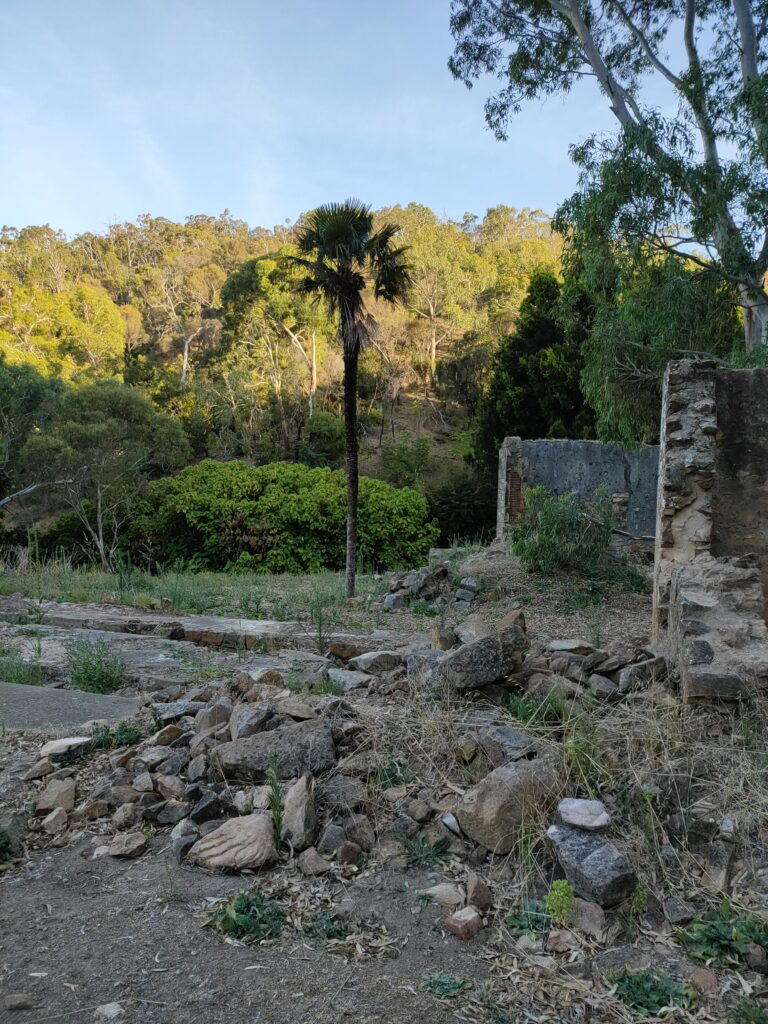
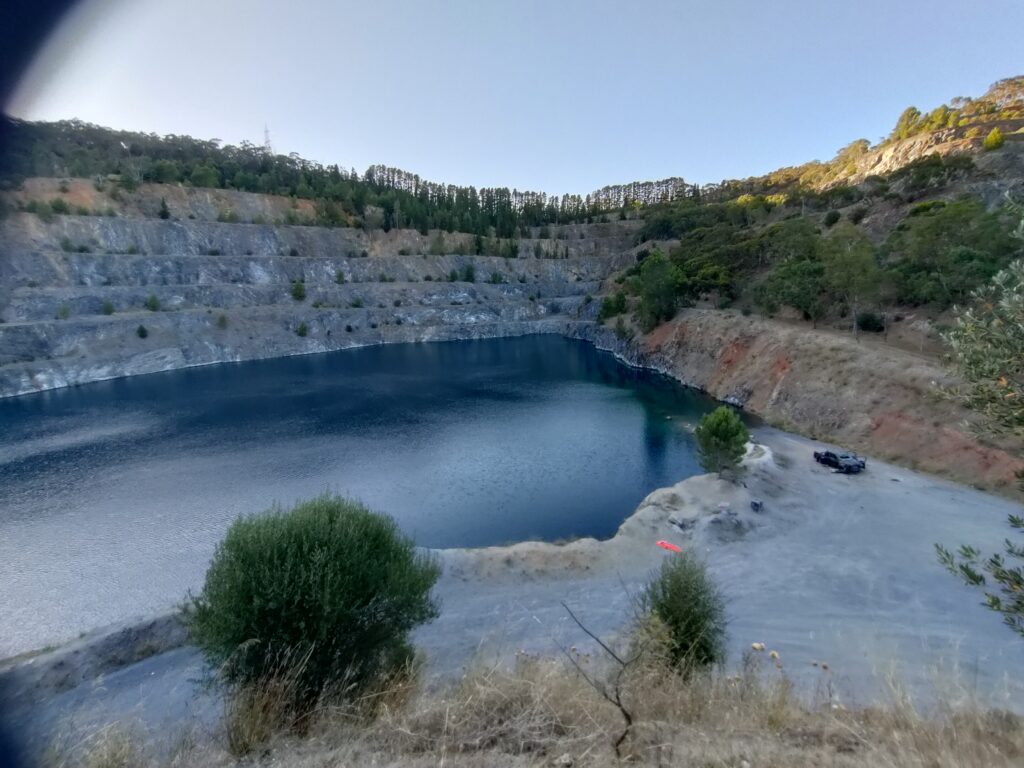
Paralysed by uncertainties, I did what I do when I don’t know what to do: I went hiking. Daily. For hours. I set my alarm early to begin as the day’s first rays were breaking and return in time for work. This was possible because I live across the road from a national park. It’s dotted with colonial ruins such as Newman’s Nursery, which was in the 1880s and 90s celebrated as the first of its kind in the new colony—a model for others—and which introduced countless feral plants that threaten local ecosystems (Taplin & Symon, 2008). Bordering the park is a fifty-hectare former slate and dolomite mine filled with flooded pits and quarry lakes that glow eerily blue. Both spaces are scarred by colonisation in differing ways – the park mapped and curated with interpretative trail signs celebrating so-called pioneers, the old mine gorged, scarred and sectioned off by barbed wire fences declaring Keep Out. But there are holes in the fences that nobody ever fixes, and graffiti obscures all the warnings. The owners don’t care who goes in, provided no one sues for injuries.
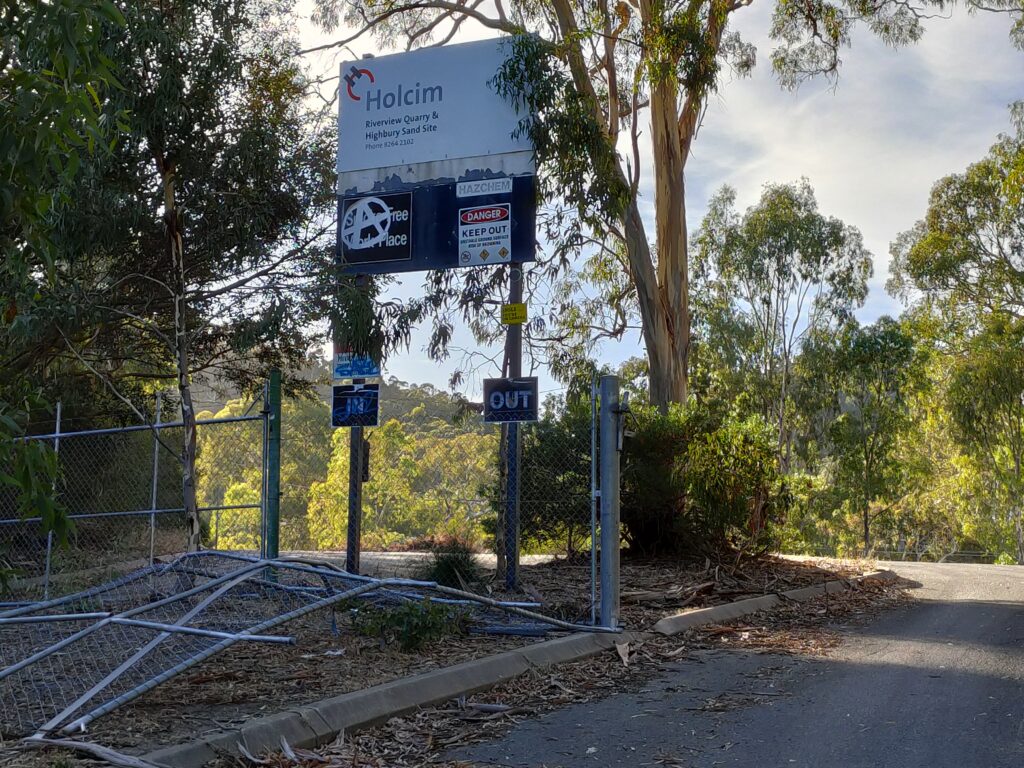
Following my hikes, I felt compelled to write about the scarred landscape in relation to my own problematic entanglements with these violences as a non-Indigenous person born into privileges stemming from the devastation colonisation has wrought. At first, I resisted this writing, which seemed an awful joke of a distraction: my book on creative writing and power was due within months, and I was frozen with uncertainties about my right to discuss such issues, yet driven towards other topics I likely bore just as little, maybe less right to be broaching.
Then I attended a poetry workshop co-led by two First Nations writers, one Barkindji and one Torres Strait Islander. I went hoping to learn how I might practice greater cultural sensitivity and respect in my writing and education practices. On arrival, I soon sensed I was, if not the only non-Indigenous writer there, then one of few. I decided it would be best to listen deeply and speak sparingly – to save space for voices of people who were graciously permitting me into this precious space. When it came time to share work we had written for an exercise, I was invited to read, but declined. Afterwards, one of the other participants beelined me.
“Have confidence in yourself”, she urged. “Your voice matters as much as anybody’s.”
She had seemingly assumed I was a fair-skinned Aboriginal or Torres Strait Islander person. Awkwardly, I explained the truth, then added, “I’m here to listen and learn.”
She mused a moment, then offered something that surprised me.
“Sometimes, talking is part of the listening.”
It was a thought I’ve kept turning over in my mind ever since. I can’t claim with confidence to have fully grasped what she wanted me to understand or do with the advice. But I tried and continue trying as best I can to hear and act on it in ways honour the kindness she showed.
In terms of everyday conversation, talking as listening makes sense. If I’m deeply engaged with what someone is saying, I’ll often relay what I think they’ve said back in my own words to check if I’ve heard correctly. Or if there’s things I can’t grasp or remain curious about, I’ll ask questions, prompting the other person to clarify or expand on what they’ve said.
I began approaching my book in the same way – not as an authoritative how-to on politically-oriented reading and writing, but as one set of interjections in bigger conversations about literature’s connections with social power and change. The voice would be necessarily tentative and self-questioning. In place of any claims to being right, I foregrounded my earnest desire to try my best and let readers into this process of trying by showing my uncertainties and the ways I was working things out. I also called repeated attention to the problems of my standpoint, encouraging readers to critically consider where my cultural conditioning might be limiting my approach, and thus, to think beyond my limits, towards the ethical possibilities I was seeking but perhaps couldn’t quite reach.
With this new approach to the book, the reflections on hiking took on a new meaning and role. They weren’t distractions from what I was meant to be writing, but a crucial part of it. I wove them in as chapter openers that give readers an embodied sense of when the book was written, by whom, why, and how. They operate as a kind of extended positionality statement—a means of acknowledging and making visible the ways in which my identity shapes my perspective and potential biases. Each one considers points from published writings of First Nations scholars and/or Critical Race theorists, thus talking through my efforts of listening to and learning from these experts (while continually acknowledging that I still may not be getting it right).
Each chapter opening also links to key theories from the chapter it opens, helping to introduce those theories in more practical, grounded ways. For instance, a chapter focused on literary representation (and erasure) opens by considering the ‘trail users’ depicted in photographs on the national park’s entry signs (nearly all of them appear middle-class and white, and the very idea of a ‘trail user’ reflects a colonial mindset about human relationships with land). Another chapter about literary canon formation begins with musings on the official national park’s curious relationship with the forbidden wonderland of the disused mine site next door. In yet another, I reflect on other hikers’ clothing choices as illustrative of fashion’s relationships with power, then connect this with issues of power in the formation of aesthetic judgements about so-called literary merit. Through crafting these links, I finally became able to see how the different sections I had drafted could be brought together and reshaped to redress previous self-contradictions. I felt like the acts of walking and writing were in a very physical sense leading me through the shape of the book, showing me what belonged where, and why.
But these practices of walking/writing as talking/listening showed me more than just the way through that one book. They continue well beyond it, ongoingly reshaping how I write and think about writing—indeed, this changes my entire way of moving through and being in the world. For while the park and mine site offer stark and obvious reflections of colonial violence and its ongoing effects, similar and intersecting modes of power, privilege and domination are evident in any space touched by human action, whether it be histories woven in the naming of streets, disability access or lack thereof in architecturally designed city buildings, frustrations expressed in toilet wall graffiti, the plants people sew in their gardens and the fences they do or don’t erect around them, and so on. I’m now alert to these details in ways I previously wasn’t. They remind me to continually check and re-check my privilege, and to carry these checks into all the words I put on paper, too. It’s an ongoing process and I relish how it keeps unfolding over time.
About the Author
Amelia Walker lives and writes on Kaurna Country, where she lectures in creative writing at the University of South Australia (soon to be Adelaide University). She has published five poetry collections, most recently Alogopoiesis (Gazebo Books). Amelia is also co-editor of Ludic Inquiries into Power and Pedagogy in Higher Education (Routledge) and author of Reading and Writing for Change (forthcoming from Bloomsbury Academic in October 2025).
Works cited
Kenneally, T. (1972). The chant of Jimmie Blacksmith. Angus and Robertson.
Moreton-Robinson, A. (2000). Talkin’ up to the white woman: Aboriginal women and feminism. UQP.
Taplin, R. L., & Symon, D. E. (2008). Remnant horticultural plants at the site of the former Newman’s Nursery, 1854—1932. Journal of the Adelaide Botanic Gardens, 22, 73–96.